


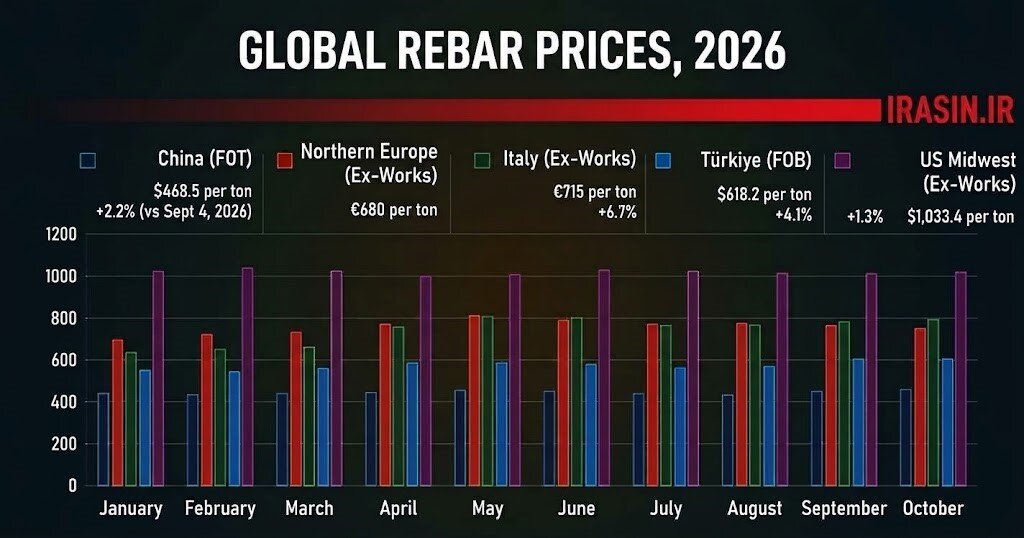
According to the analytical news outlet IRASIN, the global rebar market experienced contrasting trends across regions during the first half of October 2026. While European and American producers are seeking price hikes driven by escalating production, transportation, and energy costs, weak demand and elevated inventory levels in Türkiye and China have compelled sellers to offer discounts or adopt a cautious approach to transactions. In China, trading post-October holidays opened with relative stagnation, as subdued construction demand prevented the formation of an upward market trend.
Europe: Steelmakers Strive to Hike Rebar Prices
According to SteelOrbis estimates, Italian steel mills maintained base rebar prices in the range of €470 to €490 per ton EXW in early October. Factoring in standard size extras, effective rebar prices reached approximately €735 to €755 per ton. Kallanish estimates on October 9 placed Italian rebar prices at around €715 per ton EXW. Italian manufacturers remained confident that prices would hold at these levels, justifying hikes by the necessity to offset rising costs—particularly logistics—while maintaining relatively positive expectations for export markets.
By mid-October, Italian steelmakers continued to insist on price increases, a trend partially fueled by surging energy costs. In Northern Italy, offer prices for rebar reached €730 to €760 per ton EXW, while in Southern Italy, prices ranged from €750 to €780 per ton. Reports of even higher offer prices were also circulated. However, buyers remain unready to accept these price levels for bulk purchases, limiting transactions to small-volume orders.
Widening Price Gap Between Italian and German Rebar
A notable development in the European market is the widening price gap between rebar produced by Italian and German mills in domestic transactions—a rift that has expanded in recent weeks. Since September, German producers have applied only modest price increases, whereas their Italian counterparts adopted a more aggressive stance, raising prices more sharply.
In Germany, the base price of rebar stood at approximately €420 per ton Delivered on October 9. Including size premiums, the effective price reached roughly €685 per ton. Meanwhile, market participants report that Italian manufacturers, while maintaining high prices in their domestic market, are offering products for export at significantly lower prices to secure larger export order volumes.
United States: Rebar Prices Rise Driven by Escalating Costs
At the end of September, US rebar prices remained unchanged for the sixth consecutive week. Relative market balance and sustained demand from infrastructure and energy projects, alongside data center construction, supported price stability, offsetting reduced activity in commercial and residential real estate.
As October opened, prices were impacted by several upward drivers: a strengthening scrap market, rising freight costs, seasonal mill maintenance turnarounds, and diminished competitive pressure from imports.
Price increase announcements from major producers served as another signal for rising market prices. For instance, Nucor Bar Group and Gerdau Long Steel North America raised rebar prices for new orders by $30 per short ton, effective from specific dates in October. Nevertheless, persistent weakness in residential construction and fluctuating commercial real estate activity continue to cap a full demand recovery. According to published assessments, US rebar prices reached $1,033.4 per ton EXW on October 9.
Türkiye: Deeper Discounts Amid Sluggish Trading
The Turkish rebar market stood nearly stagnant at the end of September, weighed down by reduced trading activity and a lack of new buying orders. According to SMM assessments, Turkish steel mills had largely finalized their production schedules for the remainder of October, adopting a cautious, wait-and-see stance on sales.
Pressure on the market intensified in early October. Traders offered deeper discounts to liquidate warehouse inventories, while producers—facing weak demand and export market uncertainty—were forced to lower offer prices. This situation persisted despite shortages in specific product categories. Export market uncertainties, particularly following deteriorating security conditions in the Black Sea region, further dampened the foreign sales outlook for Turkish steelmakers.
By mid-October, the latest wave of active restocking in the Turkish domestic market concluded, constrained by several factors: carryover inventory from September purchases, slowing construction activity, and an uncertain outlook in foreign markets. Consequently, offer prices declined, and mills offered higher discounts to reduce inventory levels.
Subdued rebar demand also led to falling scrap prices and diminished buyer interest in procuring raw materials, even as imported scrap supply remained tight. According to Kallanish estimates on October 14, Turkish export rebar prices stood at $605 to $620 per ton FOB. Domestic rebar prices in Türkiye were reported in the range of $600 to $635 per ton EXW.
China: Subdued Trading Following October Holidays
The Chinese rebar market displayed weak performance immediately following the October holidays, hindered by low construction sector demand and sufficient producer inventory. However, rising coking coal futures prices during this period provided modest market support. Government measures to support the property market—particularly subsidized mortgage rates—have yet to generate a tangible recovery in construction activity, dampening expectations for the traditional autumn construction boom.
Furthermore, the slow resumption of construction projects and delays in infrastructure financing continue to constrain real steel consumption. Under these conditions, despite policy support from the government, weak end-user demand remains a major obstacle to rebar price increases.
In the short term, raw material cost volatility—especially coking coal—and mill production adjustments are expected to remain key drivers of the Chinese rebar market. Simultaneously, sluggish demand recovery and rising inventories could cap price growth. Therefore, while higher raw material costs may lend cost support to prices, persistent consumption weakness and excess inventory will constrain the market's capacity for sustained price gains. According to published data, Chinese rebar prices stood at $468.5 per ton FOT Warehouse on October 9.
Rebar Market Divergence in October
Developments in the first half of October demonstrate that the global rebar market is not following a unified trajectory due to diverging supply and demand dynamics. In Europe and the US, rising production, energy, transport, and scrap costs have pushed manufacturers toward price increases, though demand constraints continue to hinder full cost pass-through to transactions.
Conversely, Turkish and Chinese markets face weak demand, buyer caution, and inventory overhang. In Türkiye, declining construction activity and export uncertainties have led to increased discounting, while in China, stimulus policies have yet to spark a meaningful recovery in steel consumption. Overall, October rebar price trajectories depend less on a shared global direction and more on regional balances between production costs, inventory levels, and consumer purchasing power.





















نظر شما