


Mobarakeh Steel Company (MSC), standing as the undisputed backbone of Iran’s steel industry and a prominent regional player with significant competitive power, has formulated a comprehensive and integrated strategy based on six strategic pillars. This high-level roadmap is meticulously designed to navigate a series of profound structural challenges that have emerged in the modern industrial landscape. These challenges include chronic energy imbalances that disrupt production cycles, increasing water scarcity in arid regions, stringent international carbon regulations such as the European Union’s Carbon Border Adjustment Mechanism (CBAM), and the urgent necessity to enhance export competitiveness in an increasingly saturated and protectionist global market. Beyond mere short-term operational planning, this strategy serves to fundamentally redefine the company’s industrial identity, aiming for an ambitious $15 billion annual revenue target and a steadfast commitment to achieving carbon neutrality by the year 2050. At the very heart of this visionary roadmap, coastal development acts as the unifying thread, or the “string of the rosary,” linking every segment of the value chain—from raw material procurement in remote mines to the final export of high-tech advanced products through global maritime gateways.
The necessity of this strategy is rooted in a deep understanding of the geo-economic complexities surrounding the Iranian industrial sector. MSC is not merely looking to maintain its current status; it is aiming to transform into a global value chain player. This transition requires a shift from being a producer of basic steel products for the domestic market to becoming a provider of advanced materials for international industries. Each of the six pillars—operational excellence, coastal development, product diversification, technological localization, platform-based governance, and cross-border expansion—functions in complete synergy, creating a robust framework for long-term growth and regional leadership.
1. Operational Excellence and Green Production: Resilience Against Structural Imbalances The first pillar of MSC’s strategy—operational excellence and the transition toward green production—forms the bedrock of the company’s resilience against the most significant bottleneck in the domestic industry: the chronic energy imbalance. This systemic issue, characterized by severe natural gas and electricity shortages, has historically forced a reduction in the capacity utilization rate of Iranian production units from a global average of 85% to a domestic level of only 65%. Unplanned shutdowns of Electric Arc Furnaces (EAFs), especially during the extreme heat of summer months, do not just halt production; they impose staggering operational and financial costs. A single shift of furnace restart costs can reach approximately $2.5 million, turning production discipline from a predictable, proactive process into a reactive struggle for stability.
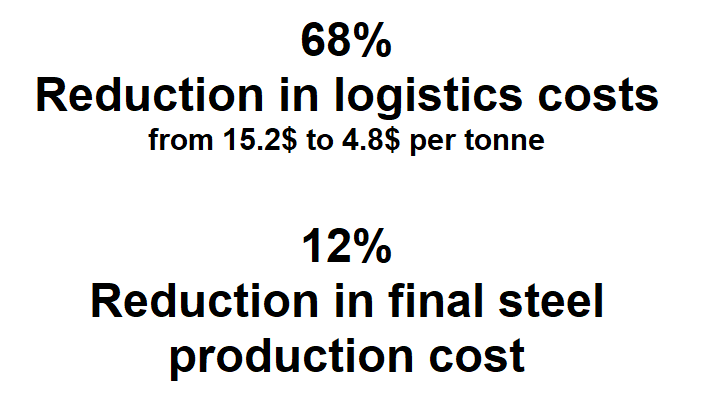
To solve this, MSC has executed a strategic investment in a 920-MW combined-cycle power plant. This facility boasts a thermal efficiency of 62%, a massive leap from the 35% efficiency typical of older simple-cycle plants. This initiative has allowed MSC to slash its operational dependency on the national power grid from 70% down to a mere 25%, effectively stabilizing production at a 99.2% consistency rate. Detailed engineering calculations reveal that this power plant saves roughly 420 million cubic meters of natural gas annually, which equates to $180 million in savings at domestic prices. This economic gain adjusts the final production cost of steel by 12% and provides the thermal stability required to manufacture specialized high-grade steels. Furthermore, MSC’s 50,000-tonne hydrogen-based direct reduction pilot project, modeled after Sweden’s pioneering HYBRIT project, aims to reduce carbon emission intensity from 2.2 to 1.5 tonnes of CO2 per tonne of crude steel.
Digital transformation is the silent engine behind this operational excellence. Through the implementation of Artificial Intelligence (AI) and the Internet of Things (IoT), MSC has installed over 5,000 advanced sensors across its production lines. This has resulted in a 12% reduction in EAF energy consumption—from 450 to 396 kWh per tonne—and raised the Overall Equipment Effectiveness (OEE) from 78% to 89%. This efficiency gain is equivalent to an additional 1.8 million tonnes of steel produced annually. Machine learning algorithms now predict thermal and mechanical anomalies with 98% accuracy, reducing unplanned downtime by 67%.
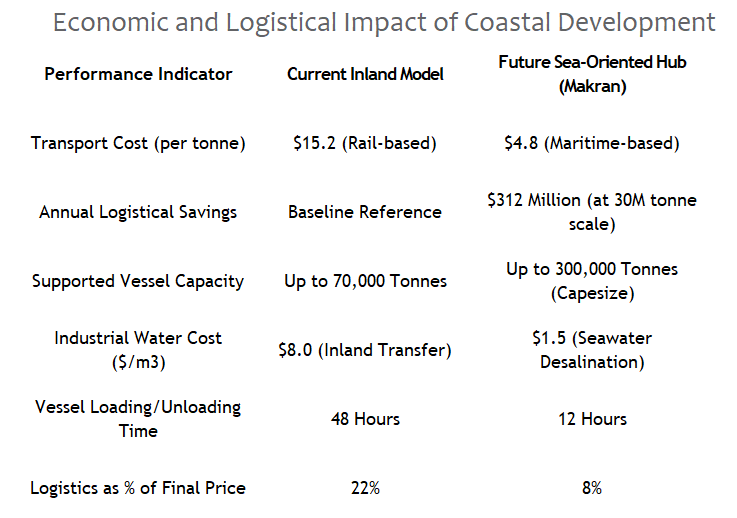
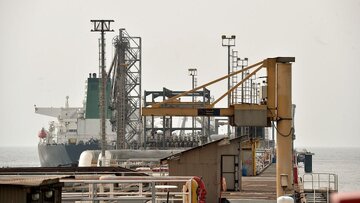
2. Coastal Development and the Sea-Oriented Hub: Redefining Industrial Geography The second pillar focuses on the industrial development of the Makran coastline, stretching from Chabahar to Jask. This move is an engineered response to three critical structural bottlenecks: prohibitive logistics costs, water scarcity, and energy instability. By strategically separating iron ore extraction at inland mines from final processing units located near deep-water ports, MSC is transforming its geographical footprint. Currently, domestic rail transport costs average $15.2 per tonne for a 1,000-km journey. By moving to maritime logistics, this cost is projected to drop to $4.8 per tonne. For a production scale of 30 million tonnes, this shift creates an incredible $312 million in annual value while simultaneously relieving the burden on Iran’s aging land transport infrastructure.
The current port infrastructure in Iran is largely limited to 70,000-tonne vessels, leading to significant demurrage penalties and slow turnaround times. By developing deep-water ports with a 20-meter draft capable of handling 300,000-ton “Capesize” vessels, MSC will reduce loading and unloading times from 48 hours to just 12 hours. Comparative analysis with India’s Vizag steel hub suggests that such sea-oriented developments can reduce total logistics costs from 22% to 8% of the final product price. In terms of water security, the Makran hub will utilize Seawater Reverse Osmosis (SWRO) technology. At a cost of $1.5 per cubic meter—vastly cheaper than the $8 required for long-distance inland water transfer—this technology provides a sustainable solution to the industrial water crisis.
3. Product Diversification and Advanced Steels: Transitioning from Volume to Value The third strategic pillar addresses the saturation of the domestic market for basic construction materials like rebar and I-beams. With domestic consumption for these products peaking at 10 million tonnes, MSC is pivoting toward high-value advanced steels. Global demand for crude steel is growing at a modest 2.25%, but the market for Advanced High-Strength Steels (AHSS), electrical steels, and stainless grades is surging at 7%. MSC is focusing its R&D and production on AHSS with a tensile strength of 1200 MPa, API-grade plates for the oil and gas sectors, and Grain-Oriented Electrical Steels (GO-ES) for transformers.
This strategic shift increases the market value per tonne from $600 for base products to $1,200 for advanced grades. AHSS is increasingly replacing conventional steel in the automotive industry, as it allows for lighter, safer, and more fuel-efficient vehicles, effectively doubling profit margins for the producer. To support this, MSC is adhering to strict logistical standards for advanced products, including temperature-controlled transport and 72-hour delivery windows. Following the roadmap of global leaders like South Korea’s POSCO—which earns 35% of its revenue from advanced products—MSC aims to achieve a 25% share of advanced steels in its portfolio by 2031. This transition effectively decouples MSC’s profitability from the volatile cycles of raw crude steel prices, ensuring a steady 22% profit margin even when global commodity prices fluctuate.
4. Technological Localization: A Shield Against Sanctions and Currency Drain The fourth pillar, technological localization, serves as MSC’s primary defense against international sanctions and currency volatility. By the end of 1403, this effort resulted in a staggering $2.9 billion in foreign exchange savings through the domestic manufacturing of 967 complex components. These range from high-pressure centrifugal pumps to IoT sensors and specialized GRP pipes. MSC has fostered an innovation ecosystem that includes 200 knowledge-based companies, top industrial universities, and the Mobarakeh Steel Technology and Innovation Development (MSTID) fund, which holds a $500 million capital base. This open-innovation platform mimics the successful models used in Japan and by POSCO in South Korea. By domesticating IoT sensor production, MSC has improved process monitoring accuracy to 98% and reduced overall maintenance costs by 40%. The long-term goal is to reduce foreign technical dependency to just 5% by 2031.
5. Enhanced Governance and Platform-Based Management: Organizational Agility The fifth pillar focuses on “Fourth Generation” corporate governance across MSC’s vast holding structure of 132 companies. This strategy redefines capital allocation based on rigorous metrics such as Return on Invested Capital (ROIC) and Economic Value Added (EVA). An AI-driven “financial brain” now predicts liquidity requirements with 95% accuracy and manages potential conflicts of interest within the holding. Inspired by Germany’s ThyssenKrupp model, MSC is transitioning from a traditional, centralized management style to an integrated digital platform. This shift has already reduced the accounts receivable period from 90 to 60 days and increased the Return on Equity (ROE) to 25%. A unified data platform has further streamlined decision-making, reducing bureaucratic delays by 50% and ensuring that the holding can pivot quickly in response to market changes.
6. Diversification, Cross-Border Expansion, and Industrial Maturity: The final pillar aims to balance the cyclical risks inherent in the steel industry by diversifying revenue streams. MSC’s goal is to derive 20% of its total revenue from non-steel sectors by 2035, specifically targeting non-ferrous mining, renewable energy, and international logistics. The strategy follows three horizons of growth: optimizing the core steelmaking operations, expanding into adjacent downstream industries like shipbuilding and oil equipment, and creating entirely new business ventures. By leveraging its coastal gateways to export a projected 30-million-tonne surplus, MSC expects to generate over $10 billion in foreign exchange revenue annually. This expansion signifies the company’s industrial maturity, moving from a domestic giant to a global multinational entity capable of competing on every continent.
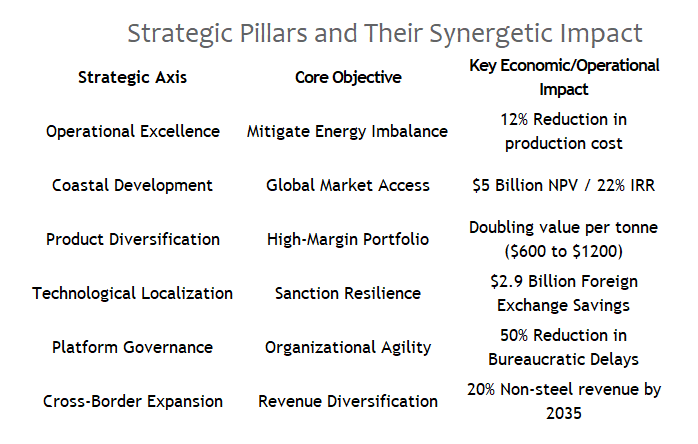
Strategic Synergy: The Path to an $18 Billion Value In summary, Mobarakeh Steel’s six strategic pillars are not isolated goals; they are an integrated, engineered response to the global and domestic challenges of the 21st century. The synergy between these axes is what creates true value. For instance, the combination of green production and coastal development reduces total energy and logistics costs by 40%, while the focus on advanced steels and localization doubles the market value of every tonne produced. Platform-based governance ensures that the financial resilience is there to sustain long-term, high-capital-expenditure growth. The total Net Present Value (NPV) of this integrated strategy is estimated at $18 billion, with a 20% internal rate of return (IRR).
By executing this roadmap with precision, Mobarakeh Steel is not only ensuring its survival in an era of global energy transitions and trade wars but is actively claiming regional leadership in the Middle East and redefining itself as a key player in the global advanced materials value chain.




نظر شما