


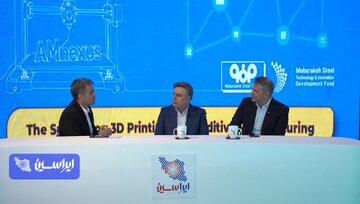
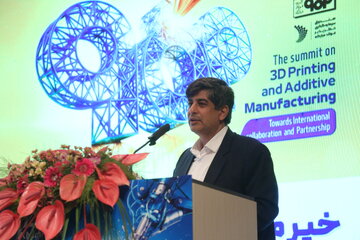
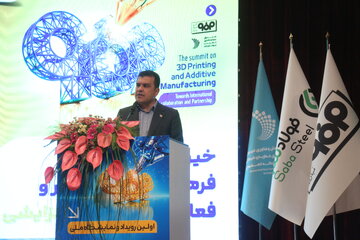
According to the analytical news outlet IRASIN, Hossein Afshin, Vice President for Science, Technology and Knowledge-Based Economy, emphasized during the 1st Specialized National Gathering of the Additive Manufacturing Value Chain—organized by the University of Tehran—that social hope stems from observing tangible, real-world results. He noted that instilling hope is an executive responsibility rather than merely a media mission, gaining strength within society when people, particularly the youth, experience the real impact of scientific and technological progress on their lives, employment, and future.
Referring to the country's economic, industrial, and social landscape alongside the challenges facing citizens and economic actors, he stated: "In a climate where the country faces economic pressures, strains on critical infrastructure, and concerns regarding the future, speaking of hope without understanding societal realities cannot be effective. Families concerned about their children's future, youth deliberating between staying or emigrating, industrialists facing raw material and component sourcing hurdles, and researchers unsure when their ideas will become products represent facets of today's reality."
Elaborating on the concept of "the dynamics of hope," the Vice President specified: "Hope is neither a static psychological state nor a fleeting emotion that can be conjured by a single speech or erased by a piece of bad news; rather, it is a dynamic phenomenon continuously generated, reinforced, or eroded."
He continued: "When a young individual senses that acquired knowledge can solve a real-world problem, motivation to learn deepens. Likewise, when a knowledge-based firm sells its product to a factory, it not only generates revenue but also reinforces confidence in domestic capabilities. Successfully solving complex industrial challenges through Iranian engineers lays the groundwork for entrusting larger responsibilities to domestic capacity."
Additive Manufacturing: A Blueprint for Shaping Iran's Future
Connecting the conceptual framework of additive manufacturing to national development, Afshin noted: "In additive manufacturing, rather than forming a part solely by subtracting material from a large block or casting it, components take shape in three dimensions layer by layer. Each layer builds upon the preceding one, ultimately creating an entirely new structure."
The Vice President framed this process as a metaphor for national development, adding: "Iran's future will not be built by a single decision, project, or technology; rather, it is the result of an interconnected series of steps. Solving an industrial problem, a knowledge-based firm entering the market, creating impactful opportunities for elite youth, and transferring technology from laboratories to production lines each constitute a layer of the country's future."
Afshin stressed: "Just as the bonding quality between layers determines component strength in additive manufacturing, the cohesion among societal elements dictates national development resilience. Academia without industry, industry without technology, technology without capital, and capital without trust cannot create a sustainable structure. Today, rather than creating isolated islands of success, we must connect existing capabilities."
Technology Must Reduce Industrial Dependency
Addressing additive manufacturing's role in transforming production processes and supply chains, he stated: "This technology is no longer merely a tool for prototyping; it is fundamentally altering the logic of design, production, and industrial supply chains."
Afshin added: "A major production line shutdown due to the lack of a single specialized component can impose severe costs on the national economy. If we can produce required industrial components domestically with high quality and reasonable costs by relying on design know-how, materials engineering, mechanical engineering, and additive manufacturing technology, something far greater than manufacturing a single part occurs: dependency is reduced, domestic capacity is forged, and new avenues for solving national challenges emerge."
Emphasizing the need to avoid superficial approaches to emerging technologies, he clarified: "Additive manufacturing is not a replacement for all traditional production methods. What matters is moving beyond demonstrating manufacturing capability to proving the sustainable operational utility of this technology in industry. The nation must transition from an economy that consumes all its capacity meeting current needs to an economy capable of designing and producing future technologies."
Industry-Academia Linkages Must Yield Contracts and Market Access
The Vice President identified knowledge-based enterprises as decisive actors in achieving this goal, noting: "Over past years, numerous memoranda of understanding have been signed and meetings convened regarding industry-academia alignment; however, placing these two sectors side-by-side does not automatically yield sustainable collaboration. This linkage requires an economic mechanism."
He elaborated: "Knowledge-based firms must be able to convert knowledge into products, and technology into innovation and wealth. Concurrently, industry must trust the capacity of Iranian technology companies; however, industry cannot run on laboratory prototypes and requires consistent quality, competitive pricing, and accountability. Genuine collaboration forms when both sides accept clear, practical commitments."
Highlighting the imperative for scientific advancement and technological breakthroughs, Afshin remarked: "Achieving Iran's rightful standing in technology cannot occur solely by expanding knowledge; the pathway to converting knowledge into industrial and economic capacity must be paved. A scientific surge will be sustainable when academic capacity, industrial capital, and knowledge-based creativity align along a shared trajectory."
Benchmark for AMnexus Success: Solving Real Industrial Problems
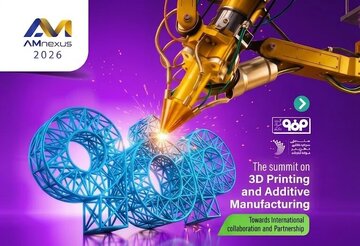
Emphasizing that the achievements of AMnexus 2026 should not be confined to hosting an exhibition and displaying milestones, he stated: "The true success of this event must be evaluated in the coming months based on the number of industrial problems solved, technologies reaching industrial testing stages, and contracts finalized between knowledge-based firms and major industries—not merely participant or booth counts."
Pointing to the capacity of Mobarakeh Steel Group and the MSTID Fund to expand the technology market, Afshin added: "This opportunity is expected to serve as a model for technology market development. Major industries must evolve beyond buyers of products into investors and technology developers, paving the commercialization path for technological breakthroughs."
He concluded: "Genuine support for technology enterprises does not necessarily mean allocating more financial capital; sometimes, providing the opportunity to test a product in a real industrial environment or placing a valid purchase order can prove far more effective than multiple rounds of financial subsidy."






نظر شما