


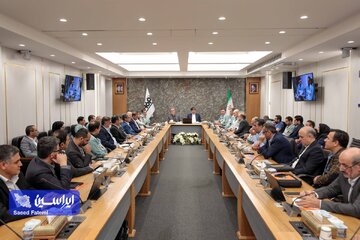
According to the analytical news outlet IRASIN, the global steel industry is undergoing broad structural transformations—a process where the shift from quantitative capacity expansion toward higher value-added products, smart technologies, and sustainable/green production has assumed new dimensions. Within this framework, Mobarakeh Steel Group, as one of the country's primary industrial drivers, stands at a pivotal juncture in its development history.
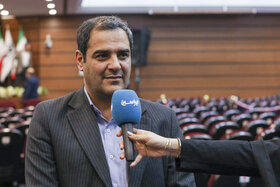
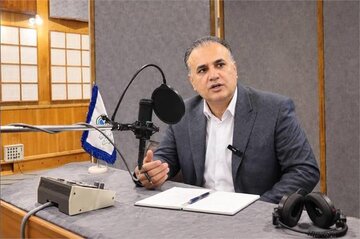
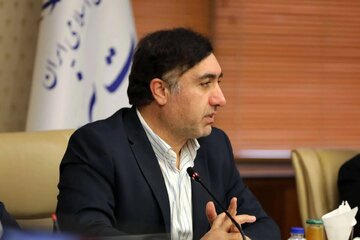
As Saeed Zarandi, CEO of Mobarakeh Steel Group, emphasizes: "Just as production and operational continuity are top priorities for the Group, we must also pay increasing attention to Mobarakeh Steel Group's cash flows within a completely transparent and systematic environment. This will allow us to achieve greater financial discipline across the Group, ultimately enhancing our competitiveness against global steelmakers while creating higher value-added for stakeholders and the nation."
Mobarakeh Steel Group's central objective under current conditions involves optimal capital management amidst an inflationary environment, energy constraints, and the financing of approximately $6 billion in development projects. In this context, transitioning from an isolated, fragmented structure to an integrated financial system, centralized treasury, and intelligent capital allocation represents a paramount strategic necessity for maintaining sustainability and regional and global competitiveness.
Theoretical and Strategic Framework of Mobarakeh Steel Group’s Integrated Financial System
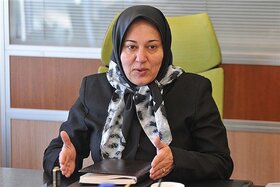
Mohammad Reza Sharifi, Vice President of Strategy and Technology Development at Mobarakeh Steel Group, outlines the logic of this new governance model: "Mobarakeh Steel Group's integrated strategy formulation model rests on seven complementary pillars: parent company vision and goals, portfolio investment strategy, parent company growth strategy, capital allocation strategy, financing strategy, corporate governance strategy, and business unit strategies... The capital allocation and financing strategies serve as the connecting link between strategic decisions and actual execution. In capital allocation, the core issue is determining where and with what priority the Group's limited capital should be deployed."
Pointing to Mobarakeh Steel Group's horizon 2035 directions, he emphasized that future development rests on six major axes, including the development of special and advanced steels, green production, business diversification, and the enhancement of governance and synergy. Limited resources must be directed precisely toward areas that generate the highest sustainable competitive advantage and value addition.
Integration Infrastructure and Centralized Treasury
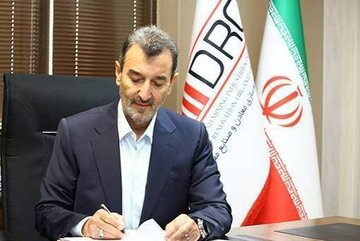
Hamed Hossein Valibeik, Vice President of Economic and Financial Affairs at Mobarakeh Steel Group, views the purpose of these new financial tools as driving transparency and coordinated liquidity management: "Establishing an integrated financial resource management system within Mobarakeh Steel Group, unifying financial planning and comprehensive budgeting across the Group, and ensuring alignment among subsidiaries... will lead to optimal resource allocation group-wide and reduce financial costs... Deploying Mobarakeh Steel Group's centralized treasury system, aimed at creating a comprehensive view of cash flows, will provide a suitable foundation for coordinated cash resource management across the Group."
Leveraging Internal Capabilities and the Financial Group Structure
Sajjad Tahmasebi, Vice President of Investment and Corporate Governance at Mobarakeh Steel Group, noting inflationary pressures and constraints on national banking resources, stated: "Establishing a comprehensive budget system and centralized treasury across the Group is among the most important anticipated achievements of this project... He expressed hope that implementing this plan will lay the groundwork for creating one of the prominent centralized treasury funds in the country, and potentially the first national model of its kind."
He also noted that the design of this comprehensive plan is the result of more than six months of specialized study, incorporating feedback from banking, capital market, and stock exchange experts.
Analysis of Key Dimensions in Mobarakeh Steel Group’s Financial Transformation
One of the most critical structural decisions involves transforming Tukasarmaye Development Company into Mobarakeh Steel Financial Group. Zarandi stated in this regard: "In the first step, Tukasarmaye Development Company was designated as the core of this structure and elevated to a group-level subsidiary. The company is undergoing a name change to Mobarakeh Steel Financial Group to become the primary vehicle for financing and supporting the operations of group companies... There are nearly $6 billion in projects within the complex whose execution requires financing."
This approach significantly reduces the reliance of the Group's eight main operating companies (such as Hormozgan Steel, Sangan Steel, Automotive Sheet, Opal Kani Pars, etc.) on the money market and expensive bank loans, while maximizing intra-group financing capabilities through instruments such as participation bonds, Rial letters of credit (LCs), treasury funds, and internal credit lines.
Artificial Intelligence, Financial Discipline, and Data-Driven Governance
In the modern world, cost management without advanced algorithmic tools remains vulnerable. Senior executive management, highlighting the role of Irisa Company in designing the information infrastructure, has made the integration of artificial intelligence with monthly performance evaluations mandatory: "Today, managing revenues and expenses without smart methods and modern tools carries serious risk... At Mobarakeh Steel Group, financial scorecards are collected monthly from vice-presidencies, and starting this month, plans to link these evaluations directly to performance metrics and employee compensation criteria are being implemented."
Ethical Principles, Administrative Integrity, and Complete Transaction Transparency
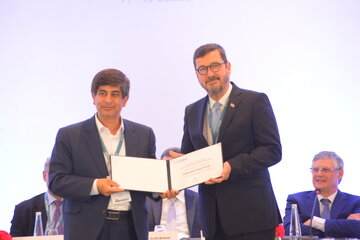
Completing the financial transformation chain is impossible without ethical and administrative discipline. An explicit emphasis on administrative integrity as an uncrossable red line, 100% offering of products on the Mercantile Exchange, and structural opposition to sole-source procurement form the management foundation of this project. Referring to the reconstruction experience of the Mobarakeh Steel complex and subsidiary companies like Sefiddasht Steel through public tender within a rapid 45-day furnace turnaround timeframe (which was ranked among the top five projects at the World Steel Association conference), the CEO of Mobarakeh Steel Group demonstrated that transparency does not hinder operational speed.
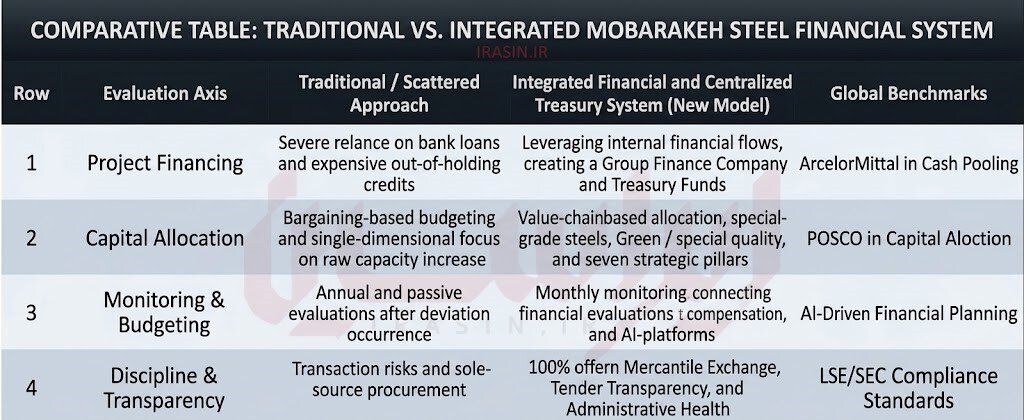
Traditional Approach vs. Mobarakeh Steel Group’s Integrated Financial System
Mobarakeh Steel Group's movement toward an "integrated financial system," "centralized treasury," and "intelligent capital allocation" represents a paradigm shift from traditional, plant-level management to world-class corporate holding governance.
This structural transformation—centered on the Financial Vice-Presidency, supported by Irisa's IT infrastructure, guided by Corporate Governance, and powered by Mobarakeh Steel Financial Group alongside the eight primary operating companies—not only hedges against risks stemming from energy constraints and inflation, but also establishes an enduring model of industrial ecosystem building, financial agility, and sustainable value creation for shareholders and the national economy.


نظر شما