


According to the analytical news outlet IRASIN, measuring industrial development solely by the number of furnaces, nominal capacity, or production output misses a critical part of the full picture. A plant aiming to expand its capacity must first ensure that the necessary feedstocks, energy, water, equipment, and auxiliary infrastructure are fully in place to support such growth.
The operational performance of Hormozgan Steel Company over the evaluated 18-month period reflects this strategic approach. From the beginning of the Persian calendar year 1404 through the end of the first half of 1405 (March 2025 to September 2026), engineering studies for 127 projects were completed, with 71 projects securing Investment Committee approval and 32 projects officially notified for execution. Within the operational portfolio, total project progress advanced from 50.57% to 57.12%. Beyond reflecting sheer engineering volume, these figures demonstrate the formation of a multi-layered development portfolio where major expansion projects move forward alongside smaller yet vital safety, efficiency, and infrastructure initiatives.
The First Bottleneck: Feedstock Security
One of the most critical links in this chain is securing the sponge iron supply. Hormozgan Steel Company's third direct reduction mega-module, with a nominal capacity of 1.72 million tons per year, plays a key role here. Project progress has advanced from 39.19% to 46.62%, utilizing indigenous PERED technology. However, the project's importance extends beyond adding new capacity. The plant can produce cold direct reduced iron (CDRI), hot direct reduced iron (HDRI), and hot briquetted iron (HBI)—a versatility that offers greater operational flexibility in managing steelmaking feedstocks.
From this perspective, the third mega-module represents a core element of production security strategy. Reducing reliance on external feedstock procurement, combined with the capability to produce and stockpile HBI, grants the company greater operational options during periods of natural gas restrictions.
Energy: The Hidden Infrastructure Behind Capacity
Feedstock alone does not translate into production capacity; every steelmaking expansion requires reliable energy. Industrial Gas Plant No. 2, currently at 76.46% progress, is designed to increase the output of oxygen, nitrogen, argon, and compressed air needed for future expansions. According to project specifications, this infrastructure is built to support steelmaking development up to a capacity of 2.5 million tons.
Concurrently, progress on the gas station expansion project has reached 92.98%. In the power sector, the energization of two 190 MVA transformers and the automation upgrade of the 230 kV substation have reached 97.39% completion. This collective progress highlights that capacity expansion must be engineered within the plant's energy grid long before it appears on production dashboards.
Growth Beyond Constructing New Units
Another noteworthy aspect of this portfolio is the focus on enhancing the efficiency of existing equipment. The sidewall lance project for electric arc furnaces (EAF) serves as a clear example of this strategy. Designed for the controlled injection of oxygen, gas, carbon, and lime, technical reports indicate that its implementation has boosted monthly production by approximately 5,000 tons per furnace. In addition to higher output, results include reduced specific electricity and electrode consumption, shorter tap-to-tap times, and improved slag control.
Through such projects, the company avoids relying solely on building new units to increase output; instead, it unlocks latent capacity within existing assets through technology and optimization. From an economic and operational standpoint, this path serves as an essential complement to physical plant expansion.
The Vital Role of Water in the Production Chain
On the other side of the operational equation lies water—an issue of heightened importance for industrial development in Bandar Abbas. Hormozgan Steel Company is pursuing a dual strategy: recycling industrial wastewater inside the plant while participating in municipal treated wastewater projects. The plant's industrial wastewater treatment facility, currently at 89.86% progress, is designed to recycle 280 cubic meters of treated water per hour back into the production loop.
On a broader scale, Hormozgan Steel Company holds a 15.18% stake in the Bandar Abbas sewage management project, having invested 9,680 billion Rials to date. Upon completion, approximately 550 cubic meters of treated wastewater per hour will be allocated to Hormozgan Steel Company. Consequently, water management forms an integral part of the strategy for production continuity and expansion.
The Setareh Simin Hormoz Development Project
Beyond on-site projects, Hormozgan Steel Company’s investment in Setareh Simin Hormoz demonstrates that its development vision extends beyond the factory walls. Holding a 51.34% stake, Hormozgan Steel Company has invested 35,936 billion Rials in this project to date. Setareh Simin Hormoz features a direct reduction mega-module with a capacity of 1.72 million tons per year, with potential expansion up to 2 million tons, subject to securing the necessary feedstock and energy infrastructure. Alongside Hormozgan Steel Company’s third mega-module, this project illustrates a broader effort to strengthen direct reduction capacity and feedstock security at a scale well beyond any single initiative.
Development Projects of Hormozgan Steel Company (From Early 1404 to H1 1405)
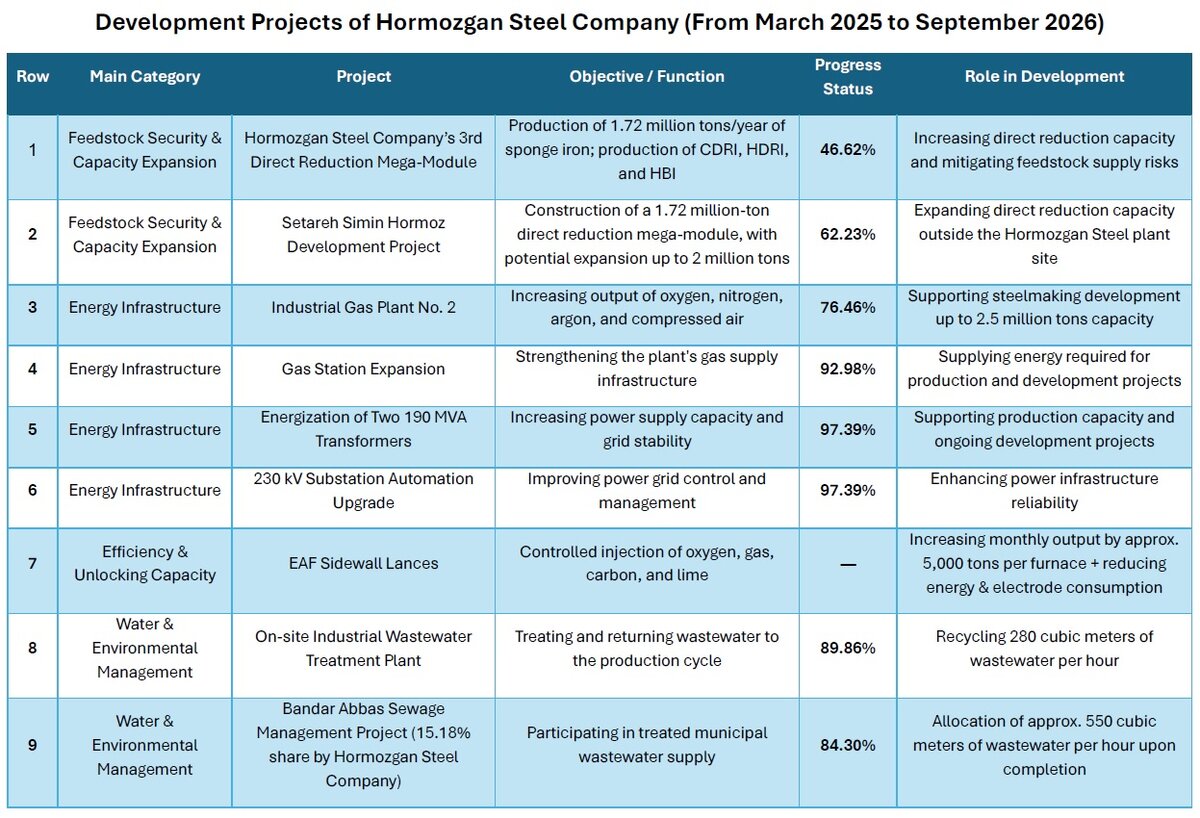
Viewing Hormozgan Steel Company’s projects individually reveals a collection of development, infrastructure, environmental, and optimization initiatives. However, analyzing them together offers a different perspective: the third mega-module targets feedstock security; gas and electricity projects bolster required energy; equipment optimization maximizes existing asset efficiency; wastewater projects mitigate water risks; and the investment in Setareh Simin creates an additional avenue for capacity growth.
From this vantage point, Hormozgan Steel Company’s development roadmap can be seen as an effort to move beyond simple "capacity expansion" toward building "sustainable production capability." New capacity creates true economic value only when the necessary feedstock, energy, water, and supporting infrastructure are fully prepared for operation. What stands out in Hormozgan Steel Company’s project portfolio is precisely the deliberate effort to build that necessary backbone.
نظر شما