
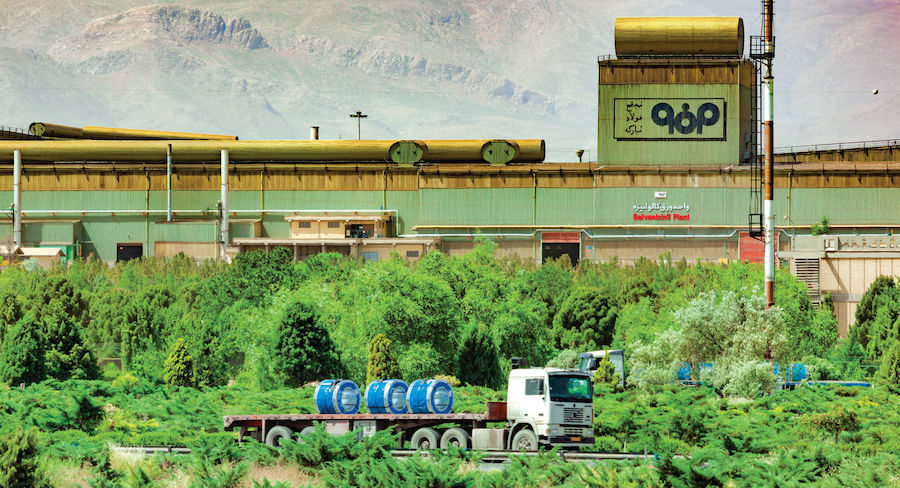

This movement is part of Mobarakeh Steel's story today—the narrative of an industry that views its responsibility as extending beyond steel production, directing a portion of its capabilities straight to human lives. The cancer screening initiative in Isfahan is not a routine project on a corporate social responsibility list. A choice was made here: the decision to direct CSR resources toward a broad societal benefit rather than stopping at constructing a building, equipping a facility, or supporting a specific group. Cancer does not discriminate based on industry, class, profession, or social status; therefore, fighting it cannot have a limited audience.
Since the launch of the breast and colorectal cancer screening initiative, more than 398,000 residents of Isfahan province have participated. This figure can easily be stated in reports and passed over, but when transformed back into human lives, it takes on a different meaning. 398,000 people means hundreds of thousands of opportunities to detect a disease before it is too late. In the breast cancer screening division, 268,849 individuals participated through the end of spring, leading to the identification of 117 cases. In spring alone, 108,115 individuals were screened, with 75% of the diagnosed cancer cases identified at stages zero, one, and two. These numbers do not merely speak of diagnosis; they speak of time—the critical window between "not yet too late" and "too late."
In colorectal cancer, this narrative becomes even clearer. During the spring season, 42,862 individuals participated in the screening program. 4,484 positive FIT tests were identified, leading to 965 colonoscopies. This process resulted in the identification of 304 polyps, of which 109 (equivalent to 36%) were diagnosed as high-risk.
Here, the story is not just about finding a disease; sometimes, it is about identifying something before it even becomes a disease. This is undoubtedly the most vital meaning of such a project: preserving human life does not always begin with treatment; sometimes it begins with timely detection. At this point, Mobarakeh Steel transcends simple logic—moving from viewing CSR as merely returning a portion of revenue to society toward understanding that organizational capabilities can be harnessed to protect the most essential asset without which no factory or society has meaning: human beings. This is precisely where a social action transforms into corporate identity.
Brand identity is not merely what a company says about itself. Over time, it is forged through real choices—what a company spends its money, attention, and energy on at critical moments. When an industry chooses an initiative spanning hundreds of thousands of people over a limited project, it speaks volumes about its core values, even without writing a single promotional slogan. This language is globally understood.
An international audience might not know the details of Iran's steel industry and may be geographically distant from Isfahan, but the concept of preserving life requires no translation. They can understand that behind an industrial brand lies a human choice. Perhaps this is the narrative of Mobarakeh Steel that should reach the world: a story that does not begin and end with a product, but transcends the product to reach humanity.
Steel is used to build houses, cars, bridges, hospitals, and infrastructure. However, the company producing this steel can also define its relationship with life. Mobarakeh Group has demonstrated this relationship through a massive social project: investing in early detection, prevention, and public health. In such a narrative, CSR is no longer a side chapter in an annual report; it becomes part of the brand story itself—the story of a brand that could have spent its resources on a smaller scale, but decided to make an impact benefiting hundreds of thousands of human beings.
Perhaps the most valuable part of this story is what remains in the end: not the number of tests, colonoscopies, or identified cases, but the simple truth that behind a massive steel complex, a decision was made to see the human being before the disease. This presents a different image of an industry, even on a global scale—an industry where power means not only production capacity, but also the ability to impact the quality of human lives.
Today, Mobarakeh Steel is not recognized solely by its products; part of its identity is forged by choices showing how this industry defines itself relative to society. If this brand's story is to be told in the global market language one day, there may be no need for grand slogans. It is enough to tell the story of a real choice: a company that produces steel, but dedicates a portion of its capacity to something even more important than steel—giving human beings more time to live. Perhaps this is the true meaning that elevates a brand beyond a mere manufacturer. Steel builds structures, but a brand that protects human life builds something far beyond structures in the public mind: trust.

نظر شما