


Industrial Framework and Sustainable Technology Founded in 1991 in Isfahan, MSC supplies over 50% of the country’s steel needs using advanced Direct Reduced Iron (DRI) technology via the Midrex process and Electric Arc Furnaces (EAF). These methods are inherently more efficient than traditional blast furnaces, reducing greenhouse gas emissions by up to 60%. The complex operates in a semi-arid region, facing inherent challenges such as water scarcity and air quality management. Consequently, the company’s CSR strategy prioritizes environmental protection, aligning strictly with the ISO 14001 Environmental Management System. Massive investments exceeding 500 trillion IRR across 15 provinces—including solar power plants and the Oman Sea water transfer project—underscore this commitment. In 2025, production reached 10.3 million tonnes, achieved through continuous record-breaking performance despite regional energy imbalances.
The Mobarakeh Steel Group, managing over 120 subsidiaries, has directly created 12,000 sustainable jobs and provides employment for 17,000 contractors. Its environmental policy emphasizes continuous performance improvement, strict compliance with Iranian Department of Environment regulations, and the development of a green supply chain. This strategic approach positions MSC as a pioneer in green steel production, fully aligned with global decarbonization objectives.
The CSR Framework: Three Pillars of Impact MSC’s CSR framework is built upon three primary pillars: environmental protection (accounting for 60% of focus), local community development, and employee health and safety. This framework is inspired by the ISO 26000 standard, with specialized committees overseeing implementation. Stakeholder engagement is maintained through annual GRI-based sustainability reports, public meetings, and online dashboards for air and water quality monitoring. Social initiatives include investing in wastewater treatment for nine neighboring cities, establishing health clinics, granting educational scholarships, and developing sports infrastructure. Collaborative studies with universities monitor indicators such as the local employment rate (exceeding 70%) and community satisfaction levels (90% based on surveys).
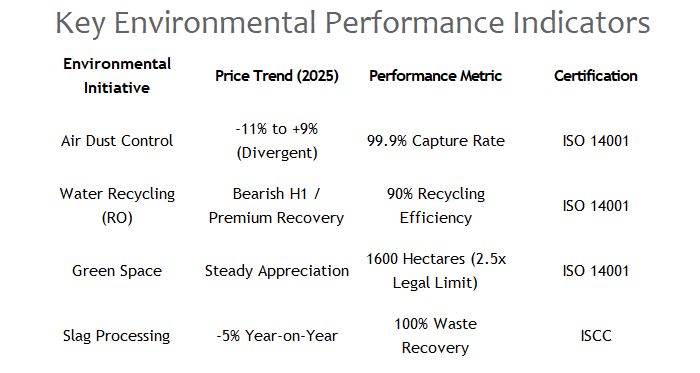
Air Quality and Emission Control MSC has invested over 3 trillion IRR in air pollution control technologies. The installation of more than 200 advanced dust collection units, including baghouses, electrostatic precipitators (ESP), and lime injection systems, has resulted in a particulate matter capture rate of 99.9%. Continuous Emission Monitoring Systems (CEMS) are installed on all stacks, transmitting real-time data to environmental authorities via SCADA systems. Independent annual audits consistently confirm compliance with global WHO standards, maintaining PM2.5 levels below 10 micrograms per cubic meter within the facility’s perimeter.
Water Stewardship and “Zero Discharge” Goals Water management is perhaps MSC’s most significant environmental achievement. Raw water consumption from the Zayandeh-Rud River has been reduced to 15 million cubic meters annually—less than 1% of the basin’s total share. Water productivity has reached 2.5 liters per kilogram of steel, a world-class benchmark. Iran’s largest Reverse Osmosis (RO) plant, with a capacity of 3000 cubic meters per hour, recycles 90% of industrial process water. By connecting to treated municipal wastewater from neighboring cities and the upcoming Oman Sea water transfer project (expected by July 2025), MSC is on track to achieve “Zero Extraction” from natural resources.
Green Energy and the “Eco-Triple” Strategy The company’s “Eco-Triple” strategy involves three axes: Eco-Process (optimizing processes), Eco-Product (low-carbon products), and Eco-Solution (renewable energy solutions). The “Aftab-e Sharq” solar power plant, with a total planned capacity of 600 MW, will offset 850,000 tonnes of CO2 emissions annually. Additionally, the 914-MW combined-cycle power plant ensures energy self-sufficiency while reducing reliance on the national grid. R&D activities include hydrogen injection pilots (launching in late 2025), Carbon Capture, Utilization, and Storage (CCUS) technology, and AI-driven predictive maintenance to reduce unplanned stops by 10%. The use of 1 million tonnes of recycled scrap annually further reduces the carbon footprint by 30%.
International Certifications and Compliance MSC has received the Integrated Management System (IMS) certification from Germany’s TÜV NORD, covering ISO 9001 (Quality), ISO 14001 (Environment), ISO 45001 (Safety), and ISO 50001 (Energy). The ISO 50001 standard has optimized energy consumption by 15%, significantly reducing Scope 1 and 2 emissions. Compliance with European REACH regulations and the EU ETS facilitates exports to over 50 countries. Membership in global initiatives such as ResponsibleSteel and the Carbon Disclosure Project (CDP) ensures international transparency. Recent acquisitions of “Cradle to Cradle” and ISCC certifications for sustainable supply chains align MSC with the EU’s Carbon Border Adjustment Mechanism (CBAM).
Future Horizons Looking toward 2031, Mobarakeh Steel aims to be among the world’s top 20 steelmakers, with a total renewable energy capacity of 2000 MW. Environmental investments have already reached 200 billion IRR, with an additional 50 billion IRR allocated annually for upgrades. These efforts have resulted in a 20% regional reduction in the PM2.5 index and the creation of 5,000 green jobs. By bridging the gap between heavy industry and ecological preservation, MSC is redefining the future of green steel in the Middle East.

نظر شما