


According to the analytical news outlet IRASIN, Iran’s steel industry stands at a juncture where moving forward with obsolete tools is no longer viable. Four decades of reliance on economies of scale, constructing new plants, and celebrating tonnage records have hit a historical ceiling. Today, energy imbalances, decarbonization pressures, and changing global market demands have entirely transformed the competitive equation. Major global steelmakers have evolved into technology-driven enterprises that sell licenses and dictate the operational rules of the industry. In such an arena, persisting with traditional models traps the domestic steel industry in an exhausting cycle where domestic producers, despite possessing high-tonnage production lines, are reduced to passive consumers of others' knowledge.
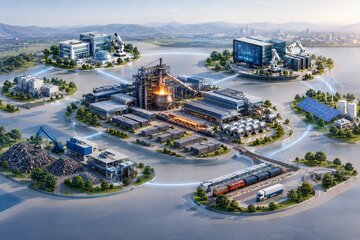
The "Future Steel" approach is designed to break this deadlock—an approach seeking solutions not in pouring concrete and purchasing new equipment, but in rearranging the flow of knowledge and technology economics. In this modern perspective, the historical chasm between laboratory and factory is bridged by converging researchers, knowledge-based companies, and production lines into a unified ecosystem, enabling ideas to translate directly into economic value within furnaces and rolling lines, free from bureaucratic friction.
For decades, our industrial managers were trapped in a traditional dichotomy regarding technology procurement: they either had to purchase and import technology externally or shoulder the entire burden of indigenization internally within their organizations, at the expense of lagging behind global knowledge frontiers. "Future Steel" transcends this dichotomy, reformulating the industry's fundamental question.
Consequently, the core question is no longer whether we should "build or buy technology," but rather "how we can harmonize the complementary capabilities of independent actors within a unified network."
In this paradigm, rather than seeking 100% technology ownership or outright acquisition of smaller firms, major steel enterprises assume the role of an orchestra conductor and ecosystem architect—an actor that aligns the capacities of universities, startups, and equipment manufacturers.
Four Strategic Directions
This novel architecture translates technological cooperation from a mere slogan into actionable implementation across four targeted, step-by-step layers:
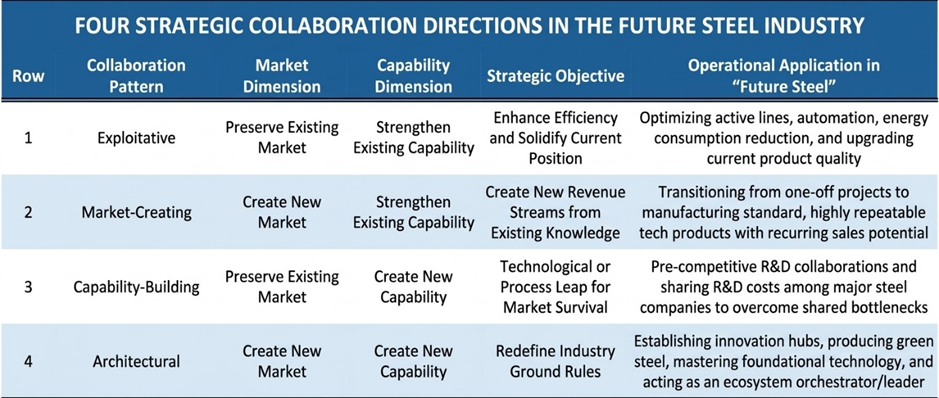
The first step originates within existing plants. Amid severe financial and energy resource constraints, the primary priority is exploitative collaboration to safeguard existing markets and fortify current capabilities. Elevating production lines to nameplate capacity, enhancing efficiency via advanced automation, and curbing energy consumption within currently operational plants represent the fastest pathways to convert technical know-how into cash flow and preserve current market standing.
However, the economic sustainability of engineering and knowledge-based divisions cannot be guaranteed by sporadic, one-off projects. The second step shifts toward market-creating collaborations—leveraging existing capabilities and expertise to forge entirely new markets. When a technical solution or intelligent system is engineered to resolve a production line bottleneck, it must be transformed into a "standardized, repeatable product" that can be repeatedly marketed to other industries and clients, generating a stable revenue stream independent of raw steel sales alone.
In the third layer, to protect export markets against threats such as carbon taxation and stringent global standards, the industry must cultivate entirely new capabilities. This is where capability-building collaborations emerge. Cultivating complex, infrastructural technologies exceeds the financial and technical capacity of any single enterprise; thus, major steelmakers must set aside insular competition, sharing R&D costs and risks collaboratively. They collectively forge novel capabilities and technologies before competing against one another in the finished product market.
The ultimate maturity of this pathway culminates in architectural collaborations—where unprecedented capabilities and novel markets are forged to rewrite the industry's rulebook. Hydrogen-based green steel development, mastery of basic engineering, and the establishment of industry-adjacent innovation complexes occupy this space. On this horizon, Iran's steel industry no longer trails global shifts, but instead emerges as a technology creator and standards setter within the region.
Transitioning to "Future Steel" is ultimately a profound mindset shift—a pivot that transforms universities from research contractors into strategic partners of production lines, and elevates major steel enterprises from raw material and energy-consuming plants into hubs of technology creation and knowledge-based wealth.

نظر شما