
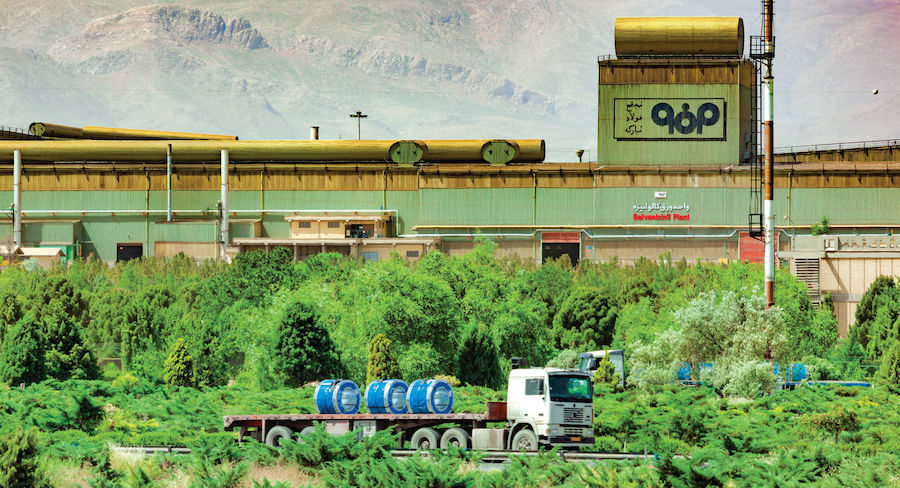

The company is building the infrastructure for a data-driven circular economy model by identifying, classifying and documenting approximately 300 operational and non-operational waste streams generated across its production chain. Central to the effort is a comprehensive Waste Atlas designed to consolidate technical knowledge, map material flows and create a foundation for recovering value from materials traditionally regarded as waste.
From Waste to Regenerating Value
In large steel plants, everything begins with raw material; iron ore, scrap, water, energy, and dozens of materials that enter a complex network of processes and are ultimately converted into products.
However, this chain yields another output as well; materials that, under the traditional perspective, are termed waste. For a long time, the primary issue was how these materials should be removed from the plant. Today, the question is shifting; how can we preserve their value and, as much as possible, return them back to the production cycle? This shift is part of a larger transformation in the steel industry toward a circular economy; a model that makes the boundary between raw material, product, and waste as flexible as possible.
Globally, companies such as Nucor have built a significant portion of their model on scrap utilization. The company states that it recycles more than 20 million tons of scrap annually and possesses more than 70 scrap recycling centers. In such a model, scrap is no longer the end of a material's life; it is the raw material for the next production. Mobarakeh Steel, with a different structure and technology, faces a broader challenge; how can hundreds of different waste streams be identified, categorized, mapped, and have their potential for returning value to the cycle increased?
The Answer Begins in Identifying Waste
In the Mobarakeh Steel complex, approximately 300 types of operational and non-operational waste are produced. Such diversity demonstrates that waste cannot be seen as a single monolithic mass. Each material has its own specific characteristics; its origin, technical specifications, processing method, and potential application differ.
Therefore, the first condition for circular management is the precise identification of materials generated at each stage of production. In this regard, Mobarakeh Steel has prioritized the development of a comprehensive Waste Atlas; a reference intended to identify, classify, and document the technical knowledge associated with these materials.
The importance of the atlas becomes apparent right at this point. A plant generating around 300 types of waste does not merely require a storage tank, a processing line, or a sales system to manage them; rather, it needs a material map, which the atlas is set to create; knowledge scattered across various divisions of the organization is consolidated into a centralized reference, enabling its use by experts and managers. As a result, waste transforms from an unknown output into a material with a clear identity, characteristics, and path. This shift in perspective is one of the foundations of a circular economy; a material cannot be returned to the cycle unless we first identify it.
From Scattered Knowledge to Organizational Memory
The atlas is not designed solely for present-day management. Documenting the technical knowledge of various types of waste also enables the preservation and transfer of organizational knowledge. In a complex industry, part of the knowledge regarding materials, processing methods, and their applications takes shape in the experience of specialized personnel. When this knowledge is recorded and categorized, it distances itself from reliance on individual memory and becomes an organizational asset.
In this way, waste management becomes linked with knowledge management; past experience can turn into future decisions, and the understanding of materials remains within the organization generation after generation.
Visibility of Waste Flow
However, having a map is not enough. One must also be able to observe the movement of materials. One of the initial challenges of waste management at Mobarakeh Steel was the dispersion of information across different systems and the absence of an integrated platform for comprehensive monitoring of the waste chain.
To address this issue, the project to develop a Waste Processing Management Dashboard was defined. This dashboard is designed to create an integrated platform for real-time monitoring of waste flow and is set to place information regarding scrap entry, processing, consumption, sales, and inventory of various types of waste into a single environment. The development of this system currently stands at approximately 60 percent progress and is predicted to be commissioned during the current year.
This transformation is not merely the digitization of information. When material flow is visible from the moment of entry through processing and consumption, the ability to identify points of loss increases as well. In other words, data becomes the new language of material management.
Waste; A Flow, Not a Point
The dashboard also provides the capability to analyze the performance of processes and contractors. This means waste management shifts from a limited activity at the end of the production line into a chain of measurable processes.
In such a system, the question is not merely how much waste was produced; rather, one can ask how much entered processing, how much was consumed, how much was sold, and what volume remained in inventory. This change reduces the distance between waste and source. The more precisely material streams are observed, the greater the capability for decision-making regarding their return to the cycle will be.
Prediction Instead of Reaction
Integrated data can also serve as the foundation for the next stage of transformation. When information regarding waste becomes precise, centralized, and analytical, the possibility of moving toward predictive analytics, process optimization, and the use of artificial intelligence will be provided. In the future, such tools can assist in more accurate waste identification and sorting; meaning that before a material turns into an issue, the plant can recognize its appropriate path. At this stage, smartization is no longer a technology project; it is part of the effort to reduce resource loss.
Circular Economy; The Intersection of Environment and Economy
The circular economy gains true importance when the environment and the economy are no longer two separate paths. Returning a material to the production cycle can simultaneously mean waste reduction, reduced resource loss, lower operational costs, and improved environmental performance.
At Mobarakeh Steel, the designed path from the comprehensive Waste Atlas to the data-driven dashboard forms this very connection; first identifying the material, then recording knowledge, then observing the flow, and finally enabling decision-making for its processing and return to the cycle.
Globally, steelmakers like Nucor have also shown that scrap can become the raw material for production on an industrial scale. Nucor states that it recycles more than 20 million tons of scrap annually. But the circular economy is not limited solely to steel scrap. The larger issue is identifying all streams that can find secondary value after their initial application ends.
From this perspective, the presence of approximately 300 types of waste at Mobarakeh Steel, rather than merely indicating complexity, can also indicate the magnitude of the opportunity. The relationship between heavy industries and nature is changing. In the linear model, nature is mainly a source of raw materials and waste is a consequence of production.
In the circular model, material must remain in the cycle as much as possible, and its value should not vanish after its first application. This shift is not just a technological transformation; it is a shift in the way we look at production.
Mobarakeh Steel, by compiling the comprehensive Waste Atlas, documenting the technical knowledge of about 300 waste types, developing a management dashboard with nearly 60 percent progress, integrating entry, processing, consumption, sales, and inventory data, and laying the groundwork for predictive analytics and artificial intelligence, is building the infrastructure for this very change.
Ultimately, the circular economy begins where industry no longer views waste as the end of the production narrative. Every material that is re-identified, processed, and returned to the cycle gains another opportunity to create value. And certainly, the future of heavy industries will be measured not just by the amount of steel they produce, but by the amount of value they can extract from the very materials existing in the cycle without consuming resources all over again.
Source: Fars News





نظر شما