


In the industrial geography of the Middle East and North Africa (MENA), Mobarakeh Steel Company (MSC) is recognized not merely as an economic enterprise but as a massive “industrial ecosystem” that stands at the pinnacle of regional crude steel production by a significant margin over its competitors. By achieving an annual production capacity exceeding 10 million tons of steel, this company has redefined production standards in the region. In the Iranian calendar year 1403 (2024-2025), through consecutive record-breaking achievements, this massive industrial complex raised its slab production to over 7.3 million tons, a figure surpassing the nominal capacity defined for its production lines. This achievement was realized while many global steelmakers grapple with energy and raw material challenges; however, MSC has guaranteed its production sustainability by leveraging smart process management and increasing line productivity.
Furthermore, the production of approximately 5.26 million tons of hot rolled coils annually demonstrates the company’s undisputed dominance over the flat products market in West Asia. The significance of this production volume becomes clear when considering that Mobarakeh Steel Company operates as a “Single Plant” and integrated complex. Centralized management of such a massive volume requires complex technical knowledge and logistical infrastructure. With a major share in Iran’s industrial gross domestic product, this company is effectively considered the anchor of stability in the regional steel market.
MSC’s volumetric leadership is not limited to numbers; this production volume has provided high bargaining power in global markets and the capability to sustainably supply large-scale infrastructure projects on an international scale. regionally, no single industrial unit can compete with the company’s 10-million-ton output. This superiority in production volume has reduced overhead costs and brought the competitive advantage of “Economy of Scale” to the company, resulting in a powerful presence among the world’s largest steelmakers and a pivotal role in the industrial development of the MENA region.
Winning Among Giants: Why MSC Stands a Head and Shoulders Above Regional Competitors
To correctly understand the industrial hegemony of Mobarakeh Steel, its performance must be evaluated not against the total production of countries, but through a precise technical comparison with major Competitor Companies in prominent nations of the region. This comparison reveals that MSC operates in a world-class league, far exceeding typical regional standards.
•In Iran: MSC, with a 10-million-ton capacity, is the undisputed leader. The closest domestic competitor, Khouzestan Steel Company, with a crude steel production capacity of about 3.6 million tons, although a significant player in billet exports, has a considerable volumetric gap with MSC. Isfahan Steel Company (ESCO), with an annual capacity of about 2.5 million tons, focuses mainly on long construction products and does not compete in the flat products sector. Companies like Sirjan Hadid South Steel, with a 2-million-ton capacity, follow in the rankings. Thus, domestically, Mobarakeh Steel Company alone produces an equivalent to the sum of several other major companies.
• In Saudi Arabia: The largest competitor in the Arabian Peninsula is the Saudi Iron and Steel Company (Hadeed), a SABIC affiliate. Although Hadeed is one of the most modern and largest steelmakers in the region, its precise production capacity remains below MSC’s 10-million-ton ceiling. Other players like Zamil Steel Holding and Al-Ittefaq Steel Products Company, despite diverse product portfolios, are not comparable to the massive MSC complex in terms of crude steel production capacity at a single site and are mostly classified as mid-tier.
• In Egypt: The Egyptian steel industry is run by several main players. Ezz Steel, along with its subsidiary EZDK, is the largest producer, but its production is distributed across several dispersed sites. Suez Steel, another Egyptian steel hub with capacities like 5 million tons of pellets and 2 million tons of hot rolled coils, plays an important role but operates on a smaller scale compared to MSC’s 7.3 million tons of slabs and 5.26 million tons of hot rolling. The combined production of Egypt’s three largest companies (Ezz, Beshay, and Suez) might approach MSC’s figures, but none reach this volume individually.
• In Turkey: Turkey, as one of the largest steel producers in Europe and the region, possesses a powerful company named Erdemir. With a production capacity of about 4 million tons of steel and 5 million tons of flat products, Erdemir is MSC’s most serious technical rival. However, even Erdemir falls below Mobarakeh Steel Company in terms of single-site melting and casting capacity.
• In the United Arab Emirates: Emirates Steel Arkan is the largest steel complex in the UAE and the Persian Gulf region. Although utilizing highly advanced technologies, its main capacity focus is on rebar and heavy sections, with a final capacity estimated at around 3 to 4 million tons, which has a significant gap compared to MSC’s 10-million-ton portfolio.
The conclusion of this comparative analysis is that Mobarakeh Steel Company is unrivaled in the MENA region in terms of Single Site Capacity.
A Complete Production Chain from Ore to Color-Coated Sheets: Diversity and Technological Depth
One of MSC’s distinguishing indicators globally is the establishment of a “Complete Production Chain” within a single site. This feature allows quality control, energy management, and productivity to be carried out at the highest possible level. The production process at this company is a complex and precise path from the heart of the earth to the final product, detailed below:
• Stage 1: Raw Material Extraction and Processing (The Foundation): The process begins with sourcing iron ore from Iran’s richest mines (Gol-Gohar, Chadormalu, Bafq, and Sangan). Incoming iron ore is first crushed and ground in processing units. Harmful impurities like sulfur, phosphorus, and silica are separated using physical and chemical methods to achieve high-purity iron concentrate. Then, in the pelletizing unit, concentrate powder is mixed with additives (bentonite) and converted into small spheres called “Pellets.” Pellets are hardened in induration furnaces to gain the necessary mechanical strength to withstand reduction furnace pressures.
• Stage 2: Direct Reduction Unit (Metallurgy of Oxygen Removal): In this critical stage, oxide pellets enter direct reduction reactors (Midrex technology). In the presence of reducing gases (hydrogen and carbon monoxide) at temperatures of about 800 to 900°C, oxygen is removed from the iron ore, producing a porous product called “Sponge Iron” (DRI) with metallization degrees above 92%. Simultaneously, auxiliary lime and dolomite production units produce and stockpile high-quality flux materials required for subsequent stages.
• Stage 3: Steelmaking (Industrial Alchemy): Sponge iron, along with scrap baskets, enters massive Electric Arc Furnaces (EAF). Materials melt under electric arcs and temperatures exceeding 1600°C. In this stage, phosphorus and sulfur slagging is performed, and primary molten steel is formed. The melt is then transferred to Ladle Furnaces (LF) for precise alloying, deoxidation, and temperature adjustment. This stage is the beating heart of special grade production, determining the final properties of the steel.
• Stage 4: Continuous Casting (Primary Forming): Refined molten steel enters continuous casting machines. The melt is injected through nozzles into water-cooled copper molds, forming an initial solidified shell. Passing through rollers and water sprays, solidification is completed, producing a product called “Slab” with thicknesses of 200 to 250 mm. The quality of solidification at this stage determines the surface and internal structural quality of the final sheet.
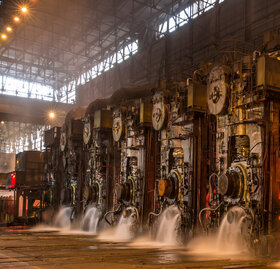
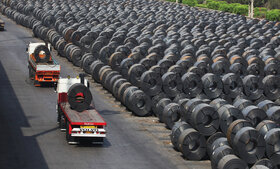
• Stage 5: Hot Rolling (Thickness Reduction and Mechanical Properties): Slabs are heated in reheating furnaces to 1200°C to achieve necessary plasticity. They then pass through Roughing and Finishing stands, where their thickness is drastically reduced (down to 1.5 mm) under immense roller pressure. Precise control of temperature and cooling rates at this stage adjusts the microstructure and mechanical properties (strength and flexibility) of the sheet. The output of this unit is “Hot Rolled Coil,” a strategic product for pipe manufacturing and steel structures.
• Stage 6: Cold Rolling and Coated Products (Final Value Added): Hot coils, after pickling (removal of surface oxides), undergo tension and pressure in the cold rolling unit to reach micrometer thicknesses (down to 0.18 mm) and excellent surface quality. Cold rolled (oiled) sheets then enter coating lines:
Galvanizing Line: Creating a zinc (Zn) coating for rust resistance.
Tinplating Line: Producing sheets specifically for packaging and canning industries (hygienic).
Color Coating Line: Applying high-variety polymeric furnace paints for decorative and construction uses.
This continuous chain enables Mobarakeh Steel Company to produce and supply everything from the simplest construction sheets to the most complex automotive body and home appliance sheets with the highest global quality.
The Vital Artery of Industry: An Irreplaceable Role
Mobarakeh Steel’s role in Iran’s economy transcends that of a manufacturer; the company acts as the “vital artery” for the country’s downstream industries. Statistics reveal an undeniable reality: allocating more than 95% of production to the domestic market is the company’s key strategy to maintain the sustainability of the national industrial chain. This supply volume meets the raw material needs of over 3,000 small and large manufacturing factories and workshops.
The domestic market’s dependence on MSC products is such that any fluctuation in the company’s production directly impacts pipe and profile, automotive, construction, and home appliance industries. By supplying about 70% of the country’s need for hot rolled coils, MSC has guaranteed supply security for downstream manufacturers, shielding them from severe currency fluctuations and import difficulties. The company’s extensive customer network has provided direct and indirect employment for over 350,000 people. In fact, many Small and Medium Enterprises (SMEs) in Iran owe their economic survival to the steady flow of high-quality MSC products. This interdependence has created a national strategic solidarity where Mobarakeh Steel Company ensures the resilience of the country’s industry against sanctions and external economic shocks.
Infrastructural Role in Strategic National and Industrial Projects
In the last decade, Mobarakeh Steel Company has moved beyond a purely quantitative approach towards qualitative and strategic production, playing a pivotal role in executing national mega-projects. The company has unlocked technical bottlenecks in the country’s vital projects by localizing special steel grades:
1. Goreh-Jask National Oil Transfer Project: Perhaps the most prominent manifestation of MSC’s technical capability is the production of Sour Service resistant sheets for the Goreh-Jask oil pipeline. Previously, Iran was entirely dependent on imports for these sheets, which must withstand corrosion caused by hydrogen sulfide. By designing the alloy and precisely controlling the thermomechanical rolling process, MSC produced the slabs and sheets required for this mega-project, placing Iran among the few producers of this technology.
2. Persian Gulf Water Transfer Projects: Massive water transfer projects from the Persian Gulf to the central plateau required high-strength steel sheets with specific thicknesses for constructing large-diameter pipes. MSC, by producing ST52 grade sheets and higher, became the main supplier of this critical infrastructure, guaranteeing water security for industries and mines in central Iran.
3. Automotive Industry: Production of Exposed automotive body sheets and deep-drawing sheets requiring exceptional surface quality and precise metallurgical properties is another strategic achievement. Producing 26 new special grades in 1403, including dual-phase and high-strength steels, allowed domestic automakers to improve vehicle body safety and quality while reducing foreign currency dependency.
4. Home Appliance Industries: Production of high-quality color-coated and galvanized sheets for refrigerator bodies, washing machines, and other appliances enabled manufacturers in this sector to compete with foreign products. MSC’s presence in the supply chain of these industries signifies self-sufficiency and industrial independence in sectors directly linked to public welfare.
Midrex Technology and Environmental Approach
In an era where the global steel industry is under scrutiny for climate accords and carbon emission reduction, Mobarakeh Steel Company is in a prime position thanks to the intelligent selection of technology at its inception and subsequent developments. Unlike many major global steelmakers (especially in China and Europe) that still rely on the “Blast Furnace” method fueled by coal and coke, Mobarakeh Steel Company utilizes “Direct Reduction” technology via the “Midrex” method.
Midrex technology is based on natural gas. Using natural gas instead of coal inherently reduces carbon dioxide (CO2) emissions significantly. In fact, the carbon footprint of steel production via the Direct Reduction - Electric Arc Furnace (EAF) route implemented at MSC is much lower than the traditional Blast Furnace-Converter method. This technological advantage has smoothed MSC’s path for transition to the “Green Steel” era, as Midrex infrastructures are adaptable for hydrogen injection in the future.
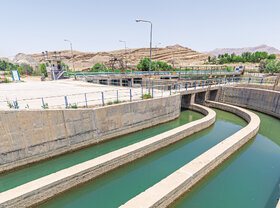
Beyond the nature of production technology, Mobarakeh Steel Company has invested heavily in environmental sustainability. The massive project of collecting and treating municipal wastewater from surrounding counties and recycling it into the production cycle has minimized the company’s reliance on raw water from the Zayandeh Rud River. Additionally, constructing high-efficiency combined cycle power plants and entering the renewable energy sector (solar power plant) are practical steps by the company to reduce fossil fuel consumption and achieve cleaner production. Installing advanced dust collection and filtration systems in steelmaking areas demonstrates the firm’s commitment to social and environmental responsibilities, making it a model for green industry in the region.
World’s Largest Producer of Sponge Iron (DRI)
One of Mobarakeh Steel’s strategic strengths, recognized globally, is its position as the “World’s Largest Producer of Sponge Iron (DRI).” According to World Steel Association statistics and performance reports, MSC, with an annual production of about 6.2 million tons of sponge iron in its direct reduction units, is the global record holder for this intermediate product.
Sponge iron is known as a high-quality, clean substitute for scrap iron in electric arc furnaces. Iran’s access to vast natural gas resources and the technical mastery of MSC engineers over the Midrex process have enabled the company to establish the largest production capacity for this product at a centralized site. Possessing this volume of high-metallization sponge iron creates two vital advantages: first, independence from the volatile global scrap market, and second, guaranteeing the chemical purity of molten steel. Since sponge iron has fewer impurities (like copper and tin) compared to scrap, producing high-quality and special alloy steels has only been possible by relying on this volume of DRI production. This global record symbolizes Mobarakeh Steel’s engineering and operational might on the international stage.
Global Ranking and International Credibility
In global rankings, Mobarakeh Steel Group has consistently consolidated its position among the world’s top steelmaking companies. According to annual reports from the World Steel Association, MSC is not only the largest producer in the MENA region but also consistently ranks among the top 25 to 40 steelmaking companies globally in terms of production volume.
However, the company’s global credibility is not limited to numbers. MSC products meet European standards, and prior to prioritizing the domestic market, the company held a significant share of export markets in Europe and East Asia. Obtaining quality management, safety, and environmental certifications from the most reputable international institutions indicates the compliance of the company’s processes with World Class standards. Active presence in specialized global conferences and recognition as a reputable brand in commodity exchanges and metal markets has transformed Mobarakeh Steel Company into Iran’s industrial ambassador to the world. This international standing has garnered the trust of business partners, technology suppliers, and foreign customers, making the brand “Mobarakeh Steel” synonymous with quality and commitment in the global steel industry.





نظر شما